







Spotlights
Corporate Attorney, Business Attorney, Corporate Counsel, In-House Counsel, Transactional Lawyer, Mergers and Acquisitions Attorney, Commercial Lawyer, Corporate Associate, Contracts Attorney, Compliance Counsel, Securities Attorney, General Counsel
Behind every company that launches a new product, merges with a competitor, raises millions in funding, or signs a major partnership deal, there is a Business Lawyer making sure the deal is built to last. This is a career for people who love strategy, want a front-row seat to how companies actually grow, and find satisfaction in solving problems before they ever become crises.
Business Lawyers, also called Corporate Lawyers, advise companies on the legal side of running and growing a business. They draft and negotiate contracts, structure mergers and acquisitions, help form new companies, guide leadership through corporate governance decisions, and make sure the business stays compliant with securities, employment, and industry regulations. They work closely with company executives, founders, investors, accountants, and other lawyers on the opposite side of a deal, translating complicated legal risk into clear guidance that leadership can actually act on. Unlike lawyers who spend their careers in courtrooms, most Business Lawyers rarely go to trial. Their job is to prevent disputes through careful drafting and negotiation, not to win them after the fact.
Using contract management software, deal data rooms, and a sharp understanding of corporate, securities, and tax law, Business Lawyers turn ambitious business plans into legally sound reality. Their work matters because a poorly written contract or a missed regulatory step can cost a company millions, while a well-structured deal can launch a product, save jobs, or turn a small startup into an industry leader.
- Helping build companies and deals from the ground up, not just cleaning up problems
- Working at the center of major business decisions and high-stakes negotiations
- Solving intricate legal and strategic puzzles that combine law, finance, and business
- Seeing tangible results, like a completed merger or a company's successful launch
Working Schedule
Business Lawyers typically work full-time, and hours can swing widely depending on deal activity. During a slower stretch, the schedule can look like a standard office job, but when a merger, acquisition, or major financing deal is closing, hours regularly stretch into nights and weekends to meet deadlines set by clients, banks, or regulators. Most work in a traditional office setting, either at a law firm or inside a company as part of an in-house legal team, with in-house roles generally offering steadier, more predictable hours than firm life.
Typical Duties
- Drafting, reviewing, and negotiating business contracts and agreements
- Advising company leadership on mergers, acquisitions, and joint ventures
- Structuring new business entities such as corporations, partnerships, and LLCs
- Conducting legal due diligence before a company invests in or acquires another
- Ensuring compliance with securities regulations and corporate governance rules
- Advising on employment agreements, vendor contracts, and licensing deals
- Preparing materials for board of directors and shareholder meetings
- Reviewing intellectual property agreements and licensing arrangements
- Coordinating with outside counsel on specialized issues like tax or antitrust law
- Advising on data privacy and regulatory compliance requirements
- Managing corporate filings and maintaining company records
- Assessing legal risk for new products, markets, or business strategies
Additional Responsibilities
- Training company employees on contract processes and compliance policies
- Managing outside law firm relationships and legal budgets
- Monitoring changes in relevant laws and regulations that affect the business
- Supporting fundraising rounds and investor negotiations for growing companies
- Reviewing marketing materials and public statements for legal risk
- Assisting with dispute resolution before issues escalate to litigation
A Business Lawyer's morning often starts with reviewing overnight emails from clients or deal counterparts in different time zones, then scanning a contract redline that came back from the other side of a negotiation. Early meetings might involve a call with company executives to walk through the legal implications of a new partnership they are considering.
Midday is usually filled with drafting and negotiating. The lawyer might spend hours marking up a purchase agreement, researching a regulatory question tied to a new product launch, or joining a call with investment bankers and accountants working through the financial details of a deal. If a client is forming a new subsidiary or closing a financing round, this is when the lawyer coordinates all the moving pieces, from signatures to filings.
Afternoons often bring internal strategy discussions, board meeting preparation, or a deep dive into due diligence documents ahead of an acquisition. Business Lawyers frequently juggle several matters at once, moving from a licensing negotiation to a compliance question to a contract dispute within the same afternoon, all while keeping business relationships smooth and deals moving forward.
Soft Skills
- Strong negotiation skills
- Clear written and verbal communication
- Strategic and business-minded thinking
- Attention to detail in complex documents
- Ability to manage multiple deals and deadlines at once
- Diplomacy when representing competing interests
- Confidence advising senior executives
- Sound judgment under time pressure
- Discretion with confidential business information
- Collaboration across departments and outside firms
- Adaptability across industries and deal types
- Persuasive, precise writing
Technical Skills
- Corporate, contract, and securities law
- Contract drafting and redlining
- Mergers and acquisitions structuring and due diligence
- Corporate governance and entity formation
- Legal research using tools like Westlaw or Lexis
- Contract lifecycle management and data room software
- Understanding of financial statements and deal valuation
- Regulatory compliance across industries such as finance, healthcare, or tech
- Basic tax law as it applies to business transactions
- Mergers and Acquisitions Attorney: Structures and negotiates the purchase or combination of companies
- Securities Attorney: Advises on stock offerings, SEC filings, and investor disclosures
- Corporate Governance Attorney: Guides boards and executives on decision-making and fiduciary duties
- In-House Counsel: Works directly for one company, handling its ongoing legal needs
- Venture Capital and Startup Attorney: Advises founders and investors on funding rounds and formation
- Antitrust Attorney: Reviews deals for competition law issues before they close
- Commercial Contracts Attorney: Focuses on vendor, supplier, and licensing agreements
- Compliance Counsel: Ensures the company follows industry-specific regulations
- Large corporate law firms with transactional practices
- Boutique business law firms
- Technology and startup companies
- Financial services firms and investment banks
- Manufacturing and consumer products companies
- Healthcare systems and pharmaceutical companies
- Real estate development and investment firms
- Private equity and venture capital firms
- Publicly traded corporations with in-house legal departments
- Nonprofit organizations with corporate governance needs
- Government regulatory agencies overseeing business and securities law
- Accounting and consulting firms with legal advisory arms
Business Lawyers are expected to be precise and fast at the same time. A misplaced clause in a contract or an overlooked regulatory requirement can expose a client to real financial and legal risk, so the pressure to get every document exactly right is constant, even when deals move quickly and deadlines are tight.
The hours can be intense, especially at large firms during active deals, where late nights and weekend work are common as a transaction approaches closing. Business Lawyers also have to manage competing priorities across multiple clients or projects, which requires strong organization and the ability to context-switch quickly without losing accuracy.
Because so much of the job involves representing one side's interests in a negotiation, Business Lawyers must stay comfortable with conflict and disagreement while keeping relationships professional. Continuous learning is part of the deal too, since business, tax, and securities law shift regularly, and lawyers who stop studying fall behind the industries they serve.
- Growth in cross-border mergers and acquisitions as companies expand globally
- Rising demand for lawyers fluent in data privacy and cybersecurity regulations
- Increased use of artificial intelligence tools for contract review and due diligence
- More companies building in-house legal teams instead of relying solely on outside firms
- Expansion of environmental, social, and governance considerations in corporate decision-making
- Growing complexity of regulations around cryptocurrency and digital assets
- Rise of remote and hybrid deal negotiations conducted over video conferencing
- Increased scrutiny of antitrust issues in large tech mergers
- More startups seeking legal guidance earlier in their formation process
- Greater use of legal technology platforms to manage contract lifecycles
Many Business Lawyers were the students who ran student council, organized a school club's budget, or started a small side business, whether that meant selling crafts online or organizing a neighborhood service. They tended to enjoy being at the center of decisions and liked figuring out how to make an idea actually work in practice.
Others gravitated toward debate, Model UN, or business and economics classes, drawn to the mix of strategy and persuasion. Many future Business Lawyers also enjoyed reading about entrepreneurs and companies, curious not just about what businesses built, but about the deals and decisions happening behind the scenes.
Becoming a Business Lawyer requires a four-year bachelor's degree followed by three years of law school to earn a Juris Doctor (J.D.). While no specific undergraduate major is required, degrees in business, economics, finance, or accounting provide a strong foundation for corporate legal work. After law school, graduates must pass the bar exam in the state where they intend to practice, and some pursue an additional Master of Laws (LL.M.) in taxation or securities law to specialize further.
Students can take courses in relevant subjects such as:
- Corporations and Business Associations
- Contracts
- Securities Regulation
- Mergers and Acquisitions
- Tax Law
- Accounting for Lawyers
- Negotiation and Deal Structuring
- Corporate Finance
- Intellectual Property Law
- International Business Transactions
Practical experience is essential in this field. Law students build real skills through business law clinics, summer associate positions at firms with transactional practices, and internships in a company's in-house legal department. Many future Business Lawyers also gain valuable perspective from prior work in finance, consulting, or a startup environment before or during law school.
- Take business, economics, and accounting courses whenever possible
- Join Model UN, debate, or student government to build negotiation and leadership skills
- Start or help run a small business, club, or fundraising project
- Read business news and follow major mergers, acquisitions, and startup stories
- Practice persuasive writing through essay and research-heavy courses
- Take a pre-law track or major in business, economics, or political science in college
- Study for and take the LSAT with plenty of time before applying to law school
- Seek internships at law firms, companies, or venture capital firms during college
- Join a business or entrepreneurship club on campus
- Practice explaining complex ideas clearly and concisely to non-experts
- Build strong Excel and financial literacy skills alongside legal knowledge
- Network with attorneys, founders, and business professionals whenever possible
- Law schools with strong business, corporate, or transactional law programs
- Faculty with real experience practicing corporate or securities law
- Access to a business law clinic or transactional skills lab
- Strong bar passage rates in the state where you plan to practice
- Opportunities to work on a business or corporate law journal
- Career services with placement connections to corporate law firms
- Externship opportunities with in-house legal departments
- Courses in negotiation, deal structuring, and corporate finance
- Strong alumni network in the business and legal community
- Reasonable tuition relative to expected starting salary in corporate law
- Options to pursue a joint J.D./M.B.A. if interested in business strategy
- Flexible scheduling if you plan to work while attending law school
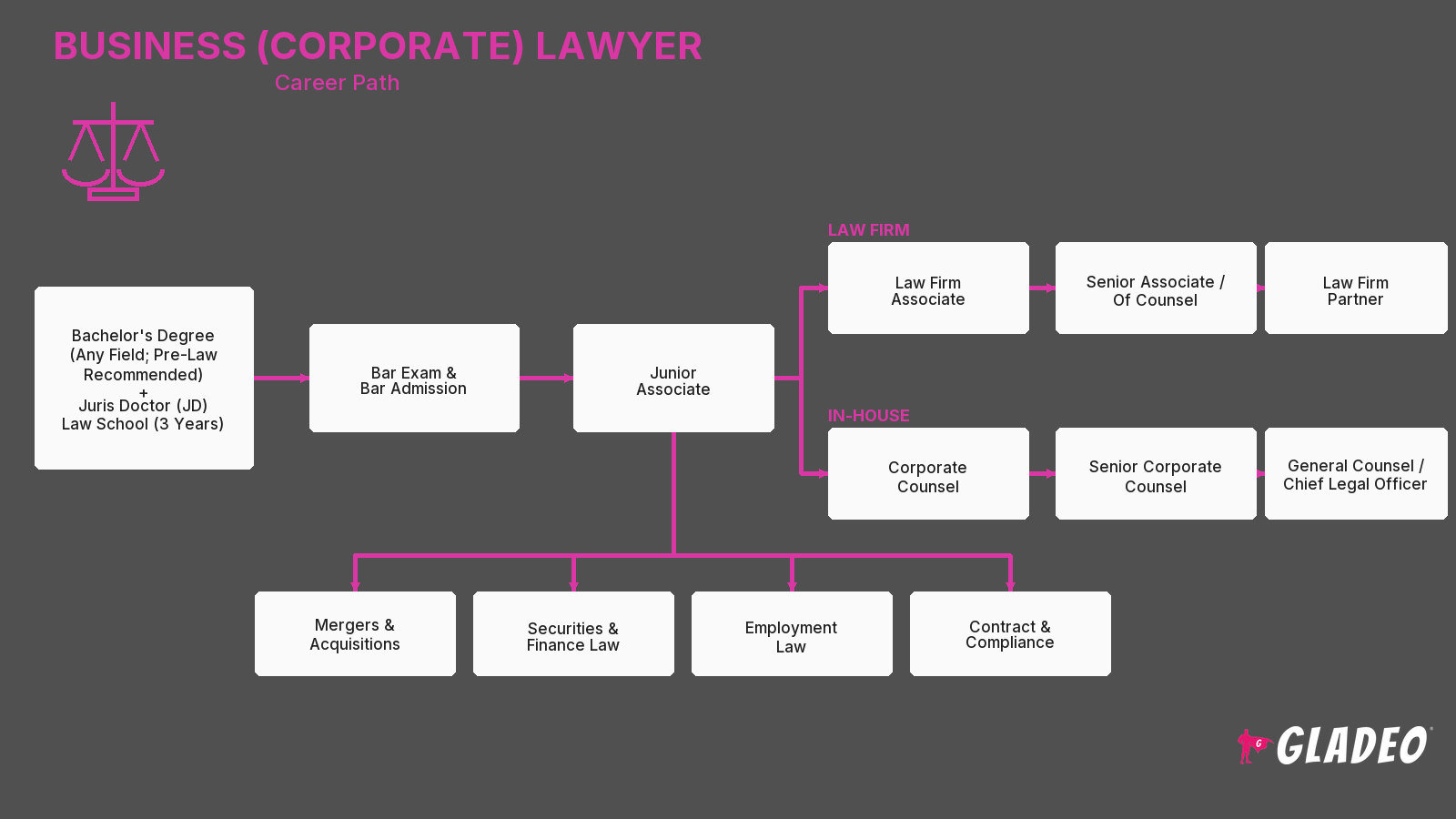
- Complete a summer associate position at a firm with a transactional practice
- Apply for entry-level roles like Corporate Associate or Junior Contracts Attorney
- Search law firm career pages and legal job boards for openings
- Attend recruiting events and on-campus interviews hosted by corporate law firms
- Network with alumni and attorneys working in business law
- Pass the bar exam and consider additional certifications in securities or tax law
- Highlight any business, finance, or entrepreneurship experience on your resume
- Build a track record of clear, careful contract drafting during internships
- Consider starting in a smaller firm to get broader deal experience early
- Practice explaining a past project or negotiation clearly in interviews
- Join local and national business law sections of the bar association
- Be open to relocating to major business hubs where deal activity is concentrated
- Build a reputation for careful, efficient contract drafting that clients trust
- Take on larger, more complex deals and cross-border transactions
- Develop a specialty, such as mergers and acquisitions, securities, or venture capital
- Build strong relationships with client executives and repeat business
- Pursue leadership roles within your firm's practice group or committee
- Move from associate to partner, or transition into an in-house General Counsel role
- Publish articles or speak at industry conferences on business law topics
- Mentor junior associates and build a strong professional network over time
Websites:
- Association of Corporate Counsel - acc.com
- American Bar Association Business Law Section - americanbar.org
- Practising Law Institute - pli.edu
- Society for Corporate Governance - societycorpgov.org
- National Venture Capital Association - nvca.org
- Delaware State Bar Association - dsba.org
- National Association of Women Lawyers - nawl.org
- Corporate Counsel Women of Color - ccwomenofcolor.org
- International Bar Association - ibanet.org
- National Association of Corporate Directors - nacdonline.org
- Law360 - law360.com
- Harvard Law School Forum on Corporate Governance - corpgov.law.harvard.edu
- American Corporate Counsel Association - acc.com
- Corporate Law Academy - thecorporatelawacademy.com
Books:
- Corporate Law by Robert Charles Clark
- Mergers, Acquisitions, and Other Restructuring Activities by Donald DePamphilis
- Business Organizations in a Nutshell by Robert W. Hamilton and Jonathan R. Macey
- Getting to Yes by Roger Fisher and William Ury
- Venture Deals by Brad Feld and Jason Mendelson
If you find that being a Business Lawyer isn't the right fit, your skills in negotiation, contract analysis, and strategic thinking transfer well to many related careers.
- Compliance Officer
- Investment Banker
- Management Consultant
- Contract Manager
- Human Resources Director
- Business Development Manager
- Paralegal specializing in corporate law
- Real Estate Attorney
- Financial Analyst
- Entrepreneur or Startup Founder
Click here to download the infographic
Newsfeed

Featured Jobs
Online Courses and Tools