







Spotlights
Bankruptcy Attorney, Insolvency Attorney, Debtor-Creditor Attorney, Consumer Bankruptcy Lawyer, Chapter 7 Attorney, Chapter 13 Attorney, Restructuring Attorney, Bankruptcy Litigation Associate, Creditors' Rights Attorney, Corporate Restructuring Lawyer, Insolvency Counsel, Bankruptcy Trustee Attorney
When a family is drowning in medical bills or a small business owner watches years of work collapse under debt they cannot outrun, a Bankruptcy Lawyer is often the person who helps them find solid ground again. This is a career built on second chances, guiding people and companies through one of the most stressful financial moments of their lives and helping them come out the other side with a real plan instead of a pile of unopened bills.
Bankruptcy Lawyers help individuals and businesses figure out whether filing for bankruptcy makes sense, and if it does, which chapter of the bankruptcy code fits their situation, whether that is a fast Chapter 7 liquidation, a structured Chapter 13 repayment plan for a family, or a complex Chapter 11 reorganization for a struggling company. They gather financial records, negotiate directly with creditors and their attorneys, prepare and file detailed court paperwork, and represent clients at hearings in front of a bankruptcy trustee or judge. Some Bankruptcy Lawyers represent the debtor trying to get relief, while others represent banks, landlords, or vendors trying to recover what they are owed, so the same case can look very different depending on which side of the table you sit on.
Using financial disclosure software, court e-filing systems, and a sharp understanding of federal bankruptcy law, Bankruptcy Lawyers turn overwhelming financial chaos into an organized, legally sound path forward. Their work matters because it keeps families in their homes, keeps small businesses alive through hard times, and keeps the credit system functioning fairly for everyone involved, debtors and creditors alike.
- Helping people who feel hopeless about debt find a legally protected fresh start
- Saving family homes, cars, and small businesses from being lost to creditors
- Solving complex financial puzzles that combine law, accounting, and negotiation
- Guiding a struggling company through reorganization so employees keep their jobs
Working Schedule
Most Bankruptcy Lawyers work full-time, and hours often track the court calendar and filing deadlines rather than a fixed nine-to-five. Solo practitioners and small-firm consumer bankruptcy attorneys frequently see clients in the evenings or on weekends, since many clients are working people who cannot take time off during the day. Lawyers who handle larger Chapter 11 corporate reorganizations tend to work longer, less predictable hours at bigger firms, especially near major filing deadlines or contested hearings. The work is split between an office preparing filings and financial disclosures, and a bankruptcy courtroom appearing before judges and trustees.
Typical Duties
- Reviewing a client's income, debts, assets, and expenses to determine bankruptcy eligibility
- Advising clients on which bankruptcy chapter fits their financial situation
- Preparing and filing bankruptcy petitions, schedules, and statements of financial affairs
- Representing debtors or creditors at the 341 meeting of creditors
- Negotiating repayment plans, debt reaffirmations, or settlements with creditors
- Filing motions to stop foreclosures, repossessions, wage garnishments, or lawsuits
- Representing clients in adversary proceedings and contested hearings before a bankruptcy judge
- Reviewing and objecting to improper creditor claims
- Advising business clients on restructuring debt while continuing operations
- Coordinating with accountants and financial advisors on complex asset valuations
- Explaining exemptions that let clients keep essential property like a home or car
- Monitoring cases through discharge and closing
Additional Responsibilities
- Staying current on changes to federal and state bankruptcy exemption laws
- Managing trust accounts and client billing in compliance with bar rules
- Training and supervising paralegals who prepare financial schedules
- Building relationships with bankruptcy trustees and local court staff
- Marketing services to reach individuals and businesses in financial distress
- Reviewing loan documents, liens, and contracts for creditor clients
A Bankruptcy Lawyer's morning often starts by reviewing the day's court calendar, checking which clients have hearings or 341 meetings scheduled, and skimming overnight emails from creditors' attorneys about proposed settlements. They might spend an hour preparing a client for what to expect at the meeting of creditors, walking through likely questions from the trustee about income and property.
Midday frequently means heading to the bankruptcy courthouse, sitting through a docket of hearings, and representing clients who are asking the court to approve a repayment plan, stop a foreclosure sale, or resolve a dispute with a creditor. Between hearings, the lawyer might grab a few minutes in the hallway to negotiate directly with opposing counsel on a settlement instead of fighting it out before the judge.
Afternoons usually shift back to the office for client meetings, where new clients bring in stacks of bills and pay stubs to be sorted into a bankruptcy petition. The lawyer reviews financial documents, drafts filings, and returns calls from anxious clients worried about a looming garnishment or repossession. Evenings sometimes include appointments with clients who could not get away from work during the day, since for many families, this meeting is the first time anyone has offered them a real plan instead of a stack of collection notices.
Soft Skills
- Empathy for clients in financial crisis
- Clear, patient communication about complicated legal and financial concepts
- Strong negotiation skills
- Comfort with public speaking in court
- Attention to detail with numbers and deadlines
- Emotional resilience when clients are stressed or upset
- Sound judgment under pressure
- Organizational skills to manage many active cases at once
- Discretion and professionalism with sensitive financial information
- Persistence when negotiations stall
- Active listening
- Ethical integrity when handling client funds
Technical Skills
- Deep knowledge of the U.S. Bankruptcy Code and local court rules
- Legal research using tools like Westlaw or Lexis
- Court e-filing systems and electronic case management software
- Financial statement and balance sheet analysis
- Drafting bankruptcy petitions, schedules, and motions
- Understanding of contract, property, and secured transactions law
- Basic accounting and budgeting concepts
- Familiarity with credit reporting and debt collection regulations
- Negotiation and settlement drafting
- Consumer Bankruptcy Attorney: Represents individuals and families filing Chapter 7 or Chapter 13
- Business Restructuring Attorney: Guides companies through Chapter 11 reorganization
- Creditors' Rights Attorney: Represents banks, landlords, or vendors trying to recover debts
- Bankruptcy Litigator: Handles contested hearings and adversary proceedings in bankruptcy court
- Bankruptcy Trustee: Court-appointed attorney who administers cases and reviews debtor filings
- Farm and Agricultural Bankruptcy Attorney: Focuses on Chapter 12 filings for family farms and fishing operations
- Municipal Bankruptcy Attorney: Advises cities, towns, or public agencies filing under Chapter 9
- In-House Restructuring Counsel: Works inside a bank or lending company managing distressed accounts
- Solo and small consumer bankruptcy law practices
- Mid-size and large corporate law firms with restructuring practices
- Legal aid societies and nonprofit debt relief clinics
- Banks and credit unions with in-house legal or workout departments
- Bankruptcy trustee offices
- U.S. Bankruptcy Courts and clerk's offices
- Credit counseling and debt management agencies
- Real estate and mortgage companies
- Accounting and financial advisory firms with restructuring divisions
- State and federal consumer protection agencies
- Small business development centers
- Private equity and turnaround management firms
Bankruptcy Lawyers regularly work with clients who are frightened, embarrassed, or in the middle of a genuine financial emergency, which means the job carries real emotional weight even though the lawyer is not personally in crisis. Staying calm, patient, and nonjudgmental with someone who is losing their home or business, sometimes over and over throughout the day, takes energy and practice.
The work is deadline-driven and detail-heavy. A single missed exemption, an incomplete schedule, or a filing error can cost a client their car or their case, so the pressure to be precise is constant. Court dockets can be unpredictable, and hearings sometimes run long or get rescheduled, which makes planning a tidy day difficult.
Lawyers who handle larger corporate restructurings often trade some of the emotional intensity of consumer work for long hours during active cases, tight deadlines tied to court-approved timelines, and high financial stakes where mistakes can affect hundreds of employees or creditors. Either path requires ongoing study, since bankruptcy law changes with new court rulings and legislation.
- Rising consumer bankruptcy filings tied to medical debt and credit card balances
- Growth in small business Chapter 11 and Subchapter V filings after economic disruptions
- Increased use of virtual 341 meetings and remote court hearings
- More e-filing and digital document management replacing paper court files
- Expansion of student loan discharge options following recent legal rulings
- Greater scrutiny of debt collection practices under consumer protection laws
- Rise of specialized Subchapter V practices for small business reorganization
- Growing demand for bankruptcy attorneys as interest rates affect household debt
- More cross-border insolvency cases as businesses operate internationally
- Increased use of data analytics to review large volumes of creditor claims
Many Bankruptcy Lawyers were the friend who was good with numbers and good at calming people down at the same time, the kid who managed a club's budget, ran a fundraiser, or helped a family member sort out a confusing bill. They often enjoyed debate, mock trial, or student government, activities that combined arguing a position with genuine problem solving.
Others gravitated toward math, economics, or business classes and liked understanding how money and systems worked. A number of future Bankruptcy Lawyers also had a front-row seat to a family financial hardship growing up, which gave them an early, personal understanding of why having someone knowledgeable and calm in your corner during a money crisis can change everything.
Becoming a Bankruptcy Lawyer starts with a four-year bachelor's degree, followed by three years of law school leading to a Juris Doctor (J.D.). Law school does not require a specific undergraduate major, but coursework in business, economics, or accounting builds a useful foundation. After law school, graduates must pass the bar exam in the state where they plan to practice, and many bankruptcy attorneys pursue optional board certification in consumer or business bankruptcy law to demonstrate specialized expertise.
Students can take courses in relevant subjects such as:
- Bankruptcy and Debtor-Creditor Law
- Business Associations or Corporations
- Contracts
- Secured Transactions
- Accounting for Lawyers
- Federal Courts and Civil Procedure
- Commercial Law
- Real Estate and Property Law
- Tax Law
- Negotiation and Alternative Dispute Resolution
Hands-on experience matters enormously in this field. Law students build real skills through bankruptcy legal clinics, internships with bankruptcy judges or trustees, and summer positions at firms with restructuring practices. Many new bankruptcy lawyers start as clerks for a bankruptcy court judge, which offers an inside view of how cases are decided before ever representing a client.
- Take courses in economics, business, and personal finance
- Join debate team or mock trial to build argument and public speaking skills
- Take accounting or bookkeeping classes to get comfortable reading financial statements
- Volunteer with a financial literacy program or credit counseling nonprofit
- Read about how bankruptcy works and follow major business restructuring news stories
- Practice explaining complex topics simply to friends or family
- Job shadow a lawyer, paralegal, or financial advisor if possible
- Take a pre-law track or political science courses in college
- Study for and take the LSAT well ahead of law school applications
- Seek internships at law firms, courts, or legal aid organizations during college
- Build strong writing skills through composition and research-heavy courses
- Practice managing a budget or helping a family business with its finances
- Law schools with a dedicated bankruptcy or commercial law clinic
- Faculty who practice or have practiced bankruptcy law
- Externship opportunities with bankruptcy judges or trustees
- Strong bar passage rates in the state where you plan to practice
- Courses covering both consumer and business bankruptcy law
- Access to moot court and trial advocacy programs
- Career services with connections to bankruptcy and restructuring firms
- Opportunities to work on a law journal covering commercial or bankruptcy law
- Reasonable tuition relative to expected starting salary in the field
- Alumni networks active in bankruptcy and financial services law
- Programs offering coursework toward board certification in bankruptcy law
- Flexible schedules if you plan to work while attending law school
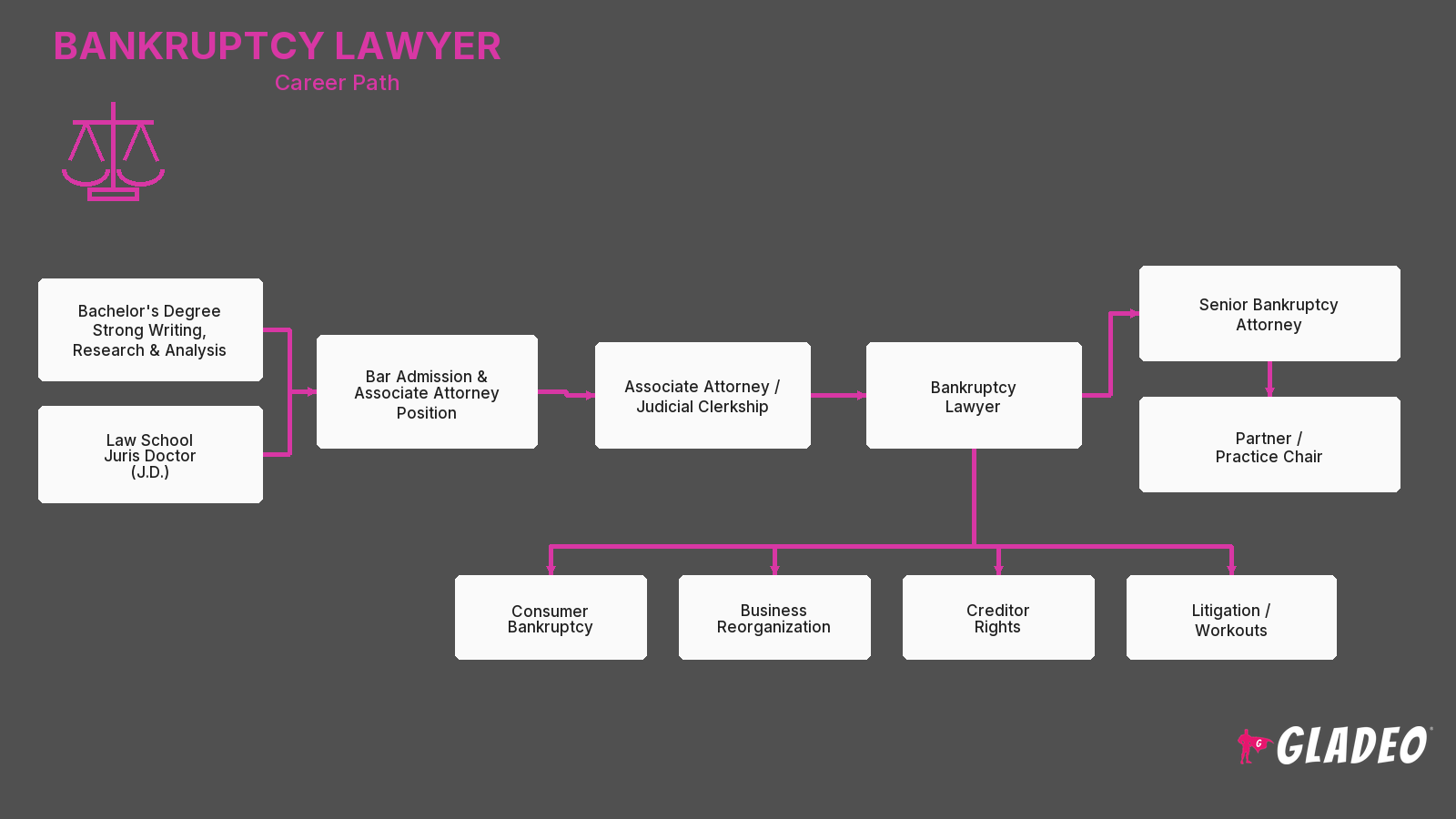
- Clerk for a bankruptcy court judge to learn how cases are actually decided
- Apply for associate positions at firms with consumer or corporate bankruptcy practices
- Look into legal aid societies and nonprofit debt relief clinics for entry-level roles
- Search job boards through your state bar association and the American Bankruptcy Institute
- Attend bankruptcy section events hosted by your state or local bar association
- Pass the bar exam and consider pursuing board certification in bankruptcy law early
- Highlight any clinic, internship, or clerkship experience prominently on your resume
- Network with bankruptcy trustees, judges, and practicing attorneys through student chapters
- Consider starting as a paralegal or law clerk at a bankruptcy firm during law school
- Practice explaining bankruptcy concepts clearly, since client trust depends on plain language
- Be open to smaller markets, where new attorneys often get courtroom experience faster
- Join the local bankruptcy bar association as a student or new-lawyer member
- Build a reputation for careful, accurate filings that trustees and judges trust
- Take on more complex Chapter 11 or Subchapter V reorganizations
- Pursue board certification in consumer or business bankruptcy law
- Develop a specialty, such as real estate, farm, or municipal bankruptcy
- Build a referral network with accountants, financial advisors, and real estate agents
- Publish articles or speak at continuing legal education events on bankruptcy topics
- Move from associate to partner, or open your own practice
- Mentor new bankruptcy attorneys and paralegals coming up in the field
Websites:
- American Bankruptcy Institute - abi.org
- National Association of Consumer Bankruptcy Attorneys - nacba.org
- American Bar Association Business Law Section - americanbar.org
- American Board of Certification - abcworld.org
- National Association of Chapter Thirteen Trustees - nact.net
- Commercial Law League of America - clla.org
- International Women's Insolvency and Restructuring Confederation - iwirc.org
- Turnaround Management Association - turnaround.org
- American College of Bankruptcy - amercol.org
- National Conference of Bankruptcy Judges - ncbj.org
- Legal Services Corporation - lsc.gov
- Federal Judicial Center - fjc.gov
- National Association of Bankruptcy Trustees - nabt.com
- American Association of Law Libraries - aallnet.org
Books:
- The Law of Debtors and Creditors by Elizabeth Warren, Jay Lawrence Westbrook, Katherine Porter, and John A. E. Pottow
- How to File for Chapter 7 Bankruptcy by Cara O'Neill
- The New Bankruptcy: Will It Work for You? by Cara O'Neill
- Chapter 11 for Small Business by Nolo Press
- A Fresh Start: How the Bankruptcy Laws Allow Insolvent Corporations to Excel by Karen Gross
If you find that being a Bankruptcy Lawyer isn't the right fit, your skills in negotiation, financial analysis, and problem solving under pressure transfer well to many related careers.
- Corporate Restructuring Consultant
- Credit Counselor
- Financial Advisor
- Real Estate Attorney
- Business Litigation Attorney
- Loan Workout Officer
- Paralegal specializing in bankruptcy
- Compliance Officer, Financial Services
- Mediator or Arbitrator
- Small Business Consultant
Click here to download the infographic
Newsfeed

Featured Jobs
Online Courses and Tools