






Spotlights
1st AD, First Assistant Director, 2nd AD, Second Assistant Director, 2nd 2nd AD, Second Second Assistant Director, Key Second AD, Set Manager, Stage Manager, Floor Director, Associate Director
Behind every movie scene that looks effortless, there is a person with a clipboard, a radio, and a plan, keeping two hundred people moving in the same direction without losing the sun, the budget, or anyone's safety. When a crowd of extras stampedes through a city street at exactly the right second, when a stunt goes off without a scratch, when a night shoot wraps before sunrise, an Assistant Director made it happen. They are the engine room of every set, and the reason the director gets to focus on telling the story.
Assistant Directors run the set so the director can run the creative vision. The 1st AD builds the shooting schedule, breaks down the script scene by scene, leads the daily call sheet, calls "rolling" and "cut," and keeps every department (camera, lighting, costume, makeup, sound, stunts, and cast) ready at the right moment. The 2nd AD handles tomorrow: they create and send out call sheets, track where every actor is and when they need to be in makeup, and manage the paperwork that proves who worked how many hours. The 2nd 2nd AD wrangles background actors, extras, and the flow of people on a busy set. Together they relay the director's vision to the crew, solve small problems before they become big ones, and keep production safe, on time, and on budget.
Assistant Directors rely on scheduling software like Movie Magic Scheduling, StudioBinder, and Gorilla, plus walkie-talkies, call sheets, shot lists, and storyboards. Their special power is communication: they speak the language of both the creative team and the money team, translating a director's dream into a realistic plan the whole crew can follow. The job is also the best-known training ground for future directors and producers. Many of Hollywood's celebrated filmmakers started out as Assistant Directors, learning how a set truly works from the inside.
- Being the person who makes a huge, complicated production actually work, and seeing the finished film or show that you helped hold together
- Leading and inspiring dozens or hundreds of talented people every day, from stunt performers to camera crews to cast members
- Having a front-row seat to every decision a director makes, which is one of the fastest ways to learn how to direct or produce yourself
- Earning respect and a strong union career path through the Directors Guild of America, with solid pay, benefits, and a close-knit professional family
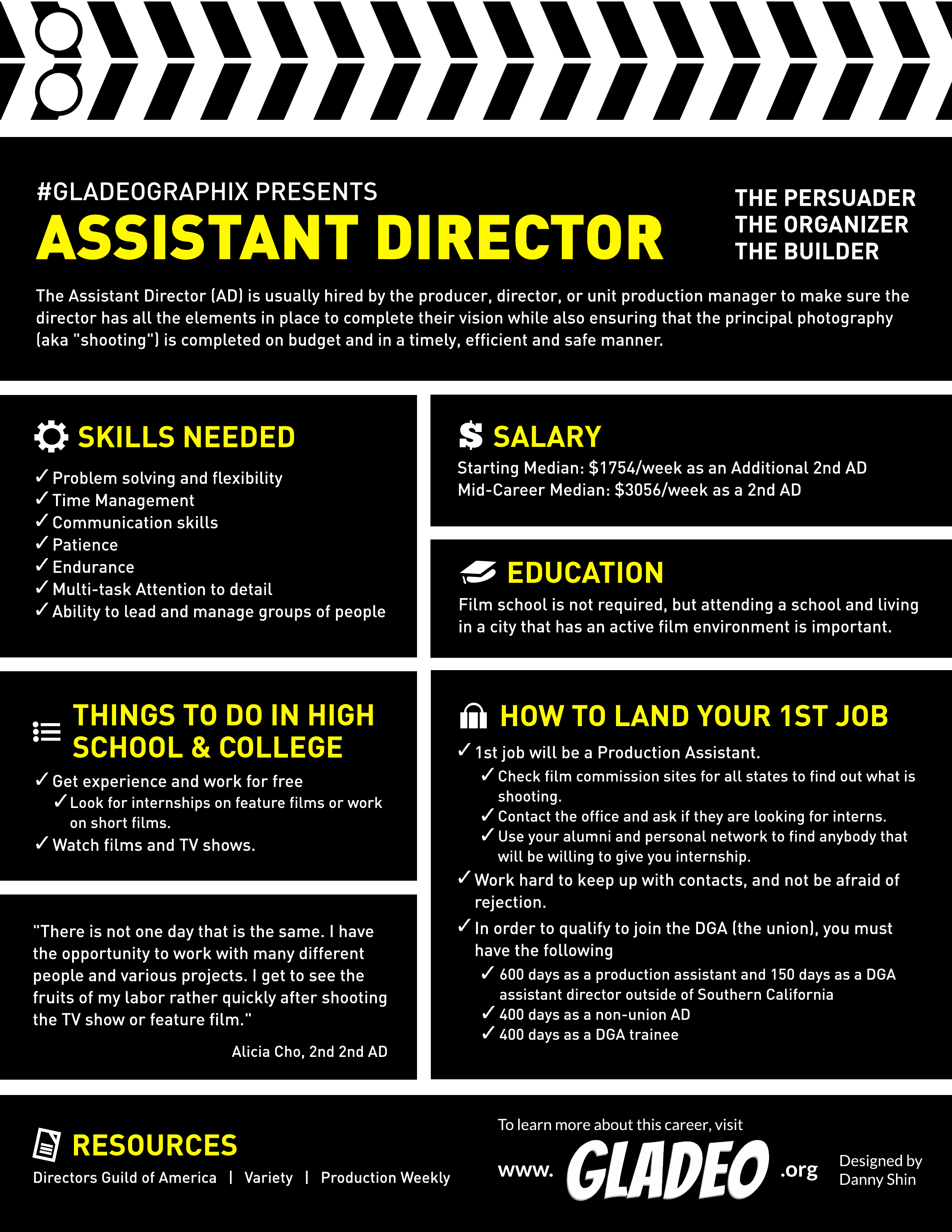
“There is not one day that is the same. I have the opportunity to work with many different people and various projects. I get to see the fruits of my labor rather quickly after shooting the TV show or feature film.” Alicia Cho, 2nd 2nd AD
Working Schedule
Assistant Directors typically work long, intense days on set, often 12 hours or more, and sometimes on nights, weekends, and holidays when a location or actor is only available then. Feature films and TV series shoot on a set schedule that can run for weeks or months, followed by a gap while the next project is lined up. Much of the work happens on location, such as soundstages, city streets, deserts, hospitals, and schools, so travel is common. Most Assistant Directors are freelancers who are hired project by project, though many are members of the Directors Guild of America and get steady work through guild contracts. Prep time before the shoot is a mix of office work in production offices, location scouts, and meetings.
Typical Duties
- Breaking down the script to identify every cast member, prop, vehicle, stunt, and special effect needed in each scene
- Building the shooting schedule, which decides what gets filmed and in what order, and updating it as problems pop up
- Creating and distributing daily call sheets that tell the cast and crew when and where to show up
- Running the set by calling out "quiet on set," "rolling," and "cut," and keeping the day moving
- Relaying the director's creative vision and instructions to every department on the crew
- Coordinating with the 2nd AD, 2nd 2nd AD, and production assistants (PAs) to manage the cast, extras, and set flow
- Watching the clock and the budget and alerting the producer or Unit Production Manager when the day is running behind
- Leading safety meetings and making sure stunts, special effects, and dangerous scenes are properly planned
- Directing background actors (extras) and managing crowd scenes
- Making sure child performers and actors with special schedules follow labor laws and union rules
- Tracking the progress of each day in daily production reports and time sheets
- Solving surprise problems, from weather delays to missing actors to broken equipment, and finding a Plan B on the spot
Additional Responsibilities
- Attending location scouts to decide what places will work for filming and what permits or road closures are needed
- Running table reads and rehearsals and helping actors prepare for key scenes
- Helping the director prioritize shots when time or light is running out
- Communicating with studio and network executives about progress and any problems
- Training and mentoring PAs and junior assistants who want to move up the ladder
- Following union rules for meal breaks, turnaround time, and overtime
- Keeping tight records of who was on set, what was shot, and any accidents or incidents
- Staying current on new safety guidelines, intimacy coordination practices, and health and wellness standards on set
An Assistant Director's day usually starts before the sun comes up. The 1st AD arrives early, sometimes by 5:00 or 6:00 AM, to meet with the director and the department heads and walk through the plan for the day. They check the call sheet, review the weather forecast, confirm that cast and crew have arrived, and make sure the first shot of the morning is ready to roll. Meanwhile, the 2nd AD checks that actors are through makeup and wardrobe and on their way to set, and the 2nd 2nd AD is gathering the background actors and sending them to the right spots.
Midday is where the 1st AD's skills really shine. They run the set, working closely with the director and the Director of Photography to line up each shot. They tell the crew when to be ready and keep an eye on the clock to make sure the day's pages are on track. If the actor needs another take, the 1st AD may quietly recalculate the schedule and adjust, perhaps combining shots or moving a scene to tomorrow. They call lunch at the right moment so nobody goes hungry or into expensive overtime. Questions from every department come at them nonstop, and they answer quickly and clearly.
In the late afternoon and evening, the pace speeds up as the light fades and the schedule gets tight. The 1st AD pushes to finish the last shots of the day, calls a wrap, and checks in with the producer and the Unit Production Manager. The 2nd AD creates and sends out the call sheet for tomorrow and the daily production report for today, then gets a few hours of sleep before doing it all over again. Between all the radio chatter, the Assistant Director's whole job is to keep everyone calm, informed, and moving toward the finish line.
*Episodic TV refers to television shows where nothing happening in one episode significantly impacts later episodes. It is unlike serial TV (like soap operas) where if you haven't watched the previous episode, it is harder to understand what is going on in the current episode.
“Monday mornings are usually an early start to the week. I go into my "office," which often varies from day to day (studio lot or on a location). I look over the call sheet when I come in, which is a one sheet summary of the scenes shooting today, background actors, principal actors, crew members and their respective call times. I also read the "sides" (script pages for the day’s work).
I grab the background actor vouchers and check them in. I make sure all the background actors are present and get them ready by taking them to wardrobe, hair and makeup. I make sure it happens in a timely matter and that the director and other creative heads do a final check and approve the look of the background actors. I have a staff of production assistants to facilitate this process. Some days there may be 5 background actors and other days there may be 500 background actors. ADs direct background actors on their movements according to the camera frame and also direct their role in the scene. I work closely with all department heads to make sure they have everything needed for the scene. I also inform the principal actors of any major changes or to communicate any the notes the director may have for them.” - Alicia Cho, 2nd 2nd Assistant Director
Soft Skills
- Leadership that inspires confidence without being bossy
- Calm under pressure when everything is going wrong at once
- Clear, loud, confident communication, especially over a radio and in a crowd
- Strong organization and time management
- Diplomacy, since you are the link between the director, the crew, the cast, and the producers
- Decisiveness when time is short and a choice has to be made right now
- Problem solving and quick thinking
- Attention to detail, from the tiniest prop to the biggest crowd scene
- Stamina and energy for long, physically demanding days
- Empathy and people skills, because every cast and crew member needs to feel heard
- Reliability and a strong work ethic
- A sense of humor that keeps morale up when the days are long
Technical Skills
- Script breakdown and scheduling using programs like Movie Magic Scheduling, StudioBinder, and Gorilla
- Creating call sheets, production reports, and daily progress reports
- Understanding of camera, lighting, and sound departments and how long each setup takes
- Knowledge of union rules, such as those of the Directors Guild of America, SAG-AFTRA, and IATSE
- Knowledge of set safety rules for stunts, firearms, special effects, and working with minors and animals
- Reading storyboards, shot lists, and floor plans
- Budgeting and cost control basics
- Understanding of film terminology and the shooting process, from pre-production through wrap
- Radio and walkie-talkie etiquette
- Using spreadsheets, scheduling apps, and messaging platforms to keep teams in sync
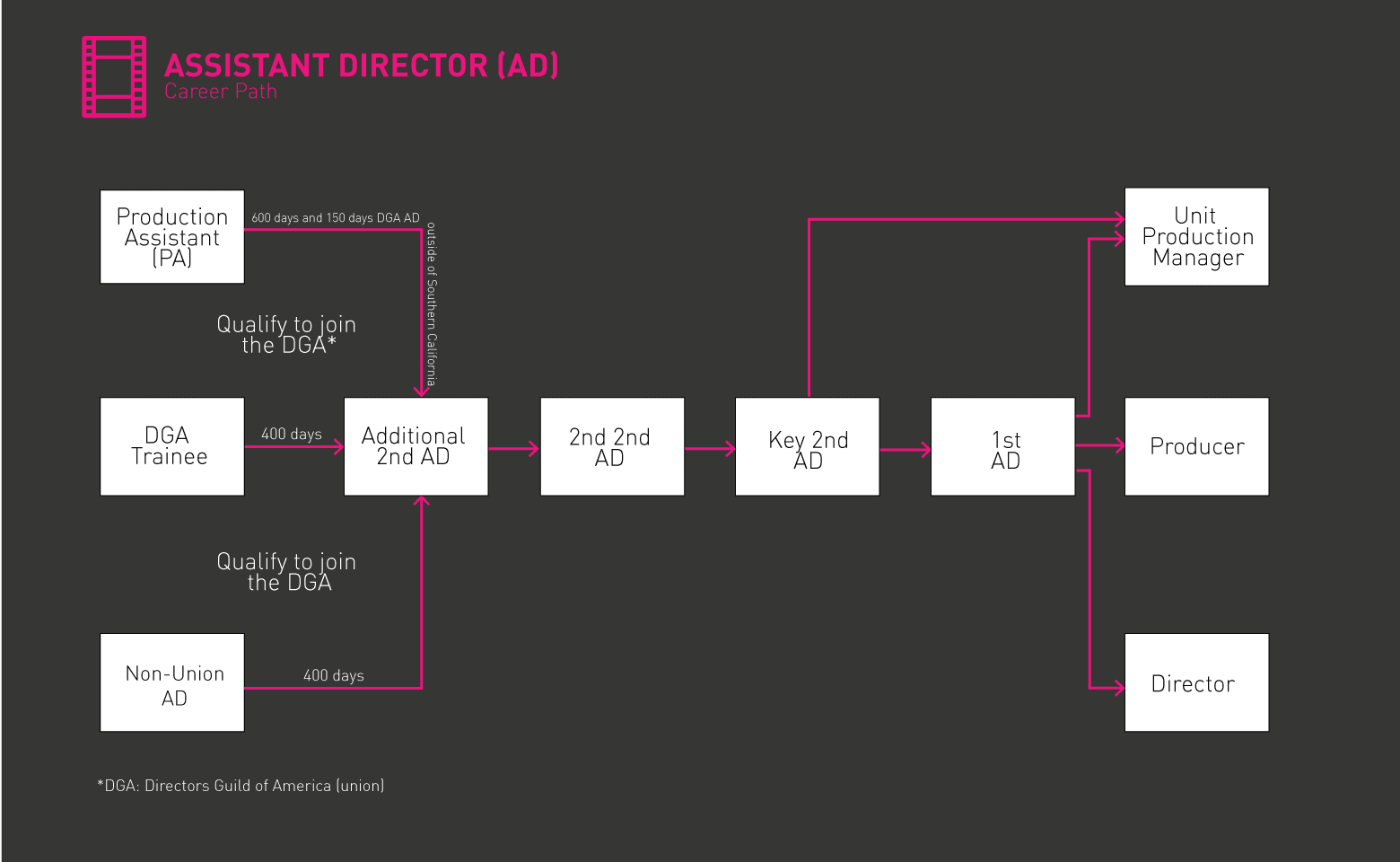
- 1st Assistant Director (1st AD): The person who runs the set, controls the schedule, and keeps the shoot moving all day
- Key 2nd Assistant Director (Key 2nd AD): The 1st AD's right hand, who builds the call sheets, manages the cast, and prepares tomorrow's day
- 2nd 2nd Assistant Director (2nd 2nd AD): Handles extras and background, helps with paperwork, and keeps the flow of people on set organized
- Additional 2nd AD: Brought in on big days to help with large crowds or complicated scenes
- Stage Manager or Floor Director: Runs live and multi-camera TV, such as talk shows, sitcoms, and awards shows
- Associate Director: A live TV role that cues cameras, graphics, and commercial breaks from the control room
- Commercial and Music Video AD: Runs fast-moving, highly visual shoots for ads, brands, and artists
- Unit Production Manager (UPM): A related management role that handles the budget, hiring, and logistics rather than the set itself
- Major film studios like Disney, Warner Bros., Universal, Paramount, and Sony
- Streaming platforms such as Netflix, Amazon, Apple TV, and HBO Max
- Television networks including NBC, CBS, ABC, and Fox
- Independent film production companies
- Commercial and advertising production houses
- Music video production companies
- Reality TV and unscripted production companies
- Live event and broadcast companies, such as sports and award show producers
- Animation and visual effects studios that film motion-capture sessions
- Corporate video production companies
- Theme parks and live entertainment companies
- Universities and film schools with production programs
Assistant Directors are the ones everyone turns to when something goes wrong, so the pressure never really lets up. The 1st AD is responsible for the safety of the entire cast and crew and for keeping the production on schedule and on budget. When a scene runs long, a star is late, or the weather turns, you are the person who has to adjust, communicate, and keep morale up. You will be asked to make decisions fast, and sometimes you will have to be the one to say no, which means your people skills need to be as strong as your scheduling skills.
The hours are long and unpredictable. Twelve- to fourteen-hour days are common, and early call times, night shoots, and weekends are part of the job. Because most work is freelance, there are gaps between projects, and it can take years of building relationships to get steady work. Time away from home on location shoots can be hard on friendships and family life, and the physical demands of standing, walking, and being outdoors in every kind of weather can be tiring.
Still, the payoff is enormous. Assistant Directors build deep trust with directors and producers, and those relationships lead to the next job. Union membership with the Directors Guild of America provides fair pay, benefits, and protections that make a long career possible. For people who love leading teams and solving puzzles in real time, there is nothing else quite like the rush of wrapping a complicated day on schedule.
- Growing use of digital scheduling and call sheet apps that update cast and crew in real time
- Expansion of streaming production, creating more series and more demand for experienced ADs
- Greater emphasis on set safety, including intimacy coordination, stunt oversight, and wellness protocols
- Virtual production and LED volume stages, which change how scenes are planned and shot
- Focus on diversity, equity, and inclusion in hiring and set culture
- Increased use of remote and hybrid pre-production meetings and virtual location scouts
- Rise of international co-productions and shooting in new filming hubs across the U.S. and the world
- More demand for AD skills in live events, esports, and streaming broadcasts
- Increased use of drones, motion capture, and complex technology that need careful scheduling
- Union efforts to improve working hours, rest periods, and fair wages for crews
Many Assistant Directors were the kid who organized the neighborhood talent show, directed the school play, or kept the group project on track when everyone else was distracted. They loved planning, making lists, running games, and leading teams, whether that was captaining a sports team, running a club, or being stage manager for the school musical. They were often the person friends turned to when they needed someone to take charge.
Others grew up filming movies with friends, making videos on a phone, or working crew on school productions and loving the behind-the-scenes energy more than the spotlight. They were fascinated by how things got made and by the teamwork that made it possible. They enjoyed puzzles, scheduling, and strategy games, and felt energized, not stressed, when plans changed at the last minute.
There is no single required degree to become an Assistant Director. Many people earn a bachelor's degree in film, television, theater, communications, or a related field, which provides a solid foundation in storytelling, production, and set etiquette. Others skip college and learn on the job, starting as production assistants and working their way up. The most important thing is real set experience, since this is a job you learn by doing.
Students can take courses in relevant subjects such as:
- Film and Television Production
- Directing and Script Analysis
- Stage Management and Theater Production
- Cinematography and Lighting Basics
- Production Management and Budgeting
- Film Editing and Post-Production
- Communications and Public Speaking
- Business and Entertainment Law
- Leadership and Team Management
- Project Management
A well-known path into the union is the Directors Guild of America and Alliance of Motion Picture and Television Producers Assistant Directors Training Program, a highly competitive program that places trainees on real productions in Los Angeles and New York. Others qualify for DGA membership by working enough days on union productions. Many Assistant Directors also build their skills through internships, film school projects, student films, and low-budget independent shoots.
Hands-on experience matters more than anything. Every extra day on set teaches you about scheduling, safety, and crew communication, and the connections you build as a PA or trainee are what lead to your first AD credits. Continuing education in safety certification, scheduling software, and leadership keeps your skills current as technology and set standards change.
- Join the school drama club and volunteer as stage manager, assistant director, or crew member for the school play
- Make short films with friends and take turns being the director, camera operator, and the person who runs the schedule
- Take classes in theater, video production, public speaking, and leadership
- Learn scheduling basics by planning events, such as a school fundraiser or a talent show, with real timelines and budgets
- Practice using free scheduling and project management tools like Google Calendar, Trello, or StudioBinder's free tools
- Volunteer or intern on local film shoots, TV productions, community theater, or live events
- Work as a production assistant on student films, indie shoots, or commercials during summer breaks
- Watch behind-the-scenes features and read about how directors and ADs work together on set
- Take first aid, CPR, and safety courses, since set safety is a core part of the job
- Join film festivals as a volunteer to meet filmmakers and see how events are organized
- Study how sports teams, live concerts, and TV broadcasts are run, since the planning is similar to a film set
- Reach out to local film commissions and film offices to find out about local productions that hire PAs
- Programs that include hands-on production work with real film sets and crew roles, not just theory
- Faculty who have worked professionally in film and television, including as ADs or production managers
- Courses in scheduling, budgeting, and production management using industry software
- Strong internship programs with studios, networks, or production companies
- Connections to industry guilds, including the Directors Guild of America and IATSE
- Access to professional-level equipment, soundstages, and screening rooms
- Alumni who are working in the industry and willing to mentor current students
- A location near a film or TV production hub such as Los Angeles, New York, Atlanta, Vancouver, or New Mexico
- Opportunities to direct, stage manage, and lead real teams, not only to be crew
- Career services that help place students in PA jobs and entry-level roles
- A culture of safety and respect on set that models professional standards
- Reasonable tuition and financial aid options, plus scholarships for film students
- Start as a production assistant (PA) on film, TV, or commercial sets and say yes to every task, because that is where relationships begin
- Search for PA jobs through Staff Me Up, Production Hub, Mandy, Facebook crew groups, and local film commissions
- Apply to the DGA and AMPTP Assistant Directors Training Program if you live in or can relocate to Los Angeles or New York
- Aim for entry-level titles like Set PA, Office PA, Production Assistant, Trainee, or 2nd 2nd AD
- Build a clean, one-page crew resume that lists your set experience, safety certifications, and software skills
- Learn scheduling software and be able to create a basic call sheet and shooting schedule to show in interviews
- Network at film festivals, industry mixers, and school screenings, and follow up with every person you meet
- Let AD departments know that you are reliable, early, and prepared, because a reputation for being easy to work with leads to repeat hiring
- Work on student and independent films to collect credits while you wait for bigger opportunities
- Move to a production hub, since the most openings are in cities where lots of projects are shooting
- Ask experienced ADs for informational conversations and listen closely to how they solve problems
- Prepare to talk about a time you handled a stressful situation or kept a team organized under pressure
- Move step by step from PA to 2nd 2nd AD to Key 2nd AD to 1st AD, learning something new on every job
- Earn your DGA membership by completing the training program or working the required number of days on union shows
- Build a reputation for being calm, fast, and fair, because directors hire ADs they trust
- Collect strong relationships with directors, producers, and Unit Production Managers who will recommend you
- Learn every department's job so you know how long things really take and can schedule with confidence
- Take on bigger shows, larger crowds, and more complex stunts to prove your leadership
- Consider branching out into live TV as a stage manager or associate director, or into unscripted and commercial work
- Use your experience to move into production management, producing, or directing, as many AD alumni do
Websites:
- Directors Guild of America (DGA) - dga.org
- Producers Guild of America - producersguild.org
- IATSE (International Alliance of Theatrical Stage Employees) - iatse.net
- Alliance of Motion Picture and Television Producers (AMPTP) - amptp.org
- SAG-AFTRA - sagaftra.org
- StudioBinder - studiobinder.com
- Entertainment Partners (Movie Magic) - ep.com
- ProductionHub - productionhub.com
- Staff Me Up - staffmeup.com
- Mandy - mandy.com
- No Film School - nofilmschool.com
- Variety - variety.com
- Deadline - deadline.com
- American Film Institute (AFI) - afi.com
Books:
- The Complete Film Production Handbook by Eve Light Honthaner
- Making Movies by Sidney Lumet
- Film Production Management by Bastian Clevé
- Directing: Film Techniques and Aesthetics by Michael Rabiger and Mick Hurbis-Cherrier
- Film Directing Shot by Shot by Steven D. Katz
If you find that being an Assistant Director isn't the right fit, your skills in leadership, scheduling, and keeping people organized can shine in many related careers.
- Unit Production Manager
- Production Coordinator
- Stage Manager
- Line Producer
- Location Manager
- Event Planner
- Script Supervisor
- Producer
- Talent Manager
- Operations Manager
“First and foremost you MUST have a passion for film and the process of making films. The politics, the egos, the extremely long hours are real and make it a tough business but if you are passionate about it, it is exciting. Being an AD is not a job, it’s a lifestyle.” – Alicia Cho, 2nd 2nd Assistant Director
Newsfeed

Featured Jobs
Online Courses and Tools